Despite the massive floods, all did go to plan. We arrived on our flight to KK on time and got picked up to go to Mt. Kinabalu National Park. About three hours later, we pulled in. We had a little chalet for the night at the base of one of the mountain trails. The place was basic, but good enough for tomorrow we set out to climb Malaysia’s tallest mountain at 4,095 meters.
Wednesday, August 25, 2010
Dull day in transit
Bats for Dinner
Evenings at the Regency Pelagus Resort are an interesting place. When we sat down to dinner, we noticed small moving shadows everywhere. Dozens of them. There was squeaking and the ever so faint sound of flapping. At first we thought large moths – they are very common in these parts of Asia – but then we realized that they were just moving too fast. Eventually, and with confirmation from the hotel staff, we realized they were bats. It was a very uncomfortable dinner. You sat crouched over your food to avoid them flying into your head – a few times they came within centimeters – and also to cover your food from falling guano. Ugh.
For some reason, Ms. Cupcake and I get it into our heads every year when planning these trips that we love nature. We speak so happily and confidently about our trips into rainforests, etc., seemingly forgetting, each time and every year, that when actually in said rainforest we are positively petrified of the various and sundry forms of nature that surround us.
This evening we also took the night nature walk. Just as a quick refresher, the jungles of Sarawak, especially after intense periods of rain, are full, and I mean full, of leeches. As a result, Ms. Cupcake spent most of this hour long jungle hike jumping at just about everything. Our guide heard the purr of a civet cat within feet but her shriek at spotting a leech on her shoes made the cat scurry away. It was nonetheless an interesting trek – we saw giant ants, flat headed frogs and some lizards. I won’t pretend like I was entirely comfortable either, but I managed to save my unhappy reaction for later when I realized that I had a large leech crawling on my hand.
We went to a longhouse village in the morning. Do you remember how I said that the trip to Sarawak was intended to be another trip to see relatively primitive tribes, etc.? Well, yeah – not so much. I knew that it was going to be miles apart from PNG, but, honestly, there were no similarities at all. What we’ve seen out in Sarawak is an incredible testament to the economic development of Malaysia over the past couple of decades and especially the past few years.
Longhouses are traditionally built as one massive room in a house that is very long. The entire village stays in this one long house. The house is built of wood and the inside is full of headhunting relics from the old days. We did not see any of this.
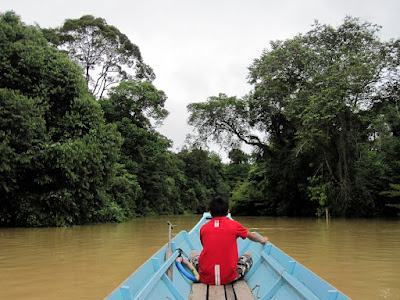
We arrived at our relatively remote longhouse village in the pouring the rain on a motorized canoe. As we moved up the Pelagus river, a tributary of the Rajang, I saw the bright paint and cinderblocks. Not exactly what I had expected. The longhouse was actually very similar to a US apartment building, but instead of going skywards, it was long. There were 46 families in the longhouse and each had its own apartment. The apartments were all about 1200 – 1500 sqft and those who could afford it had nice furnishings, televisions, tile floors, proper kitchens, etc. The village did not yet have a government electricity supply (though that is expected in the coming year), but every family had their own generator. Our guide told us about 90% of the village was Christian, with only some of the older and highly tattooed gentlemen still believing in ancestral spirits.
He said that 80%+ of longhouses were now fully modern like this one and those that were not would be in the next few years. He said that journalists often come looking for traditional longhouses and he gets somewhat irritated – he rightly pointed out that villages that live in a traditional longhouse essentially have missed all of the development that has taken place – they lack the money and resources that other areas have to upgrade and that is something to be sad about, not sought after. Fair point. Whether for tourism or architectural preservation, no one has the right to begrudge these people their advancement in an increasingly developed and modern economy.
Even with the all the modern conveniences present, some tradition certainly remained. Some of the younger gentlemen were also tattooed. People still sat outside of their private apartments in the very long public hallway and spoke to their neighbor. All references to home were to the longhouse, not my home or even my village. Nonetheless, lots of the families living in the longhouse were actually not there. Malaysians are some of the world’s most sought after migrant workers – they are educated, a very high percentage speak English and many of them have experience in natural resource extraction and other engineering pursuits. As such, many go to work in the rest of the South Pacific, the Gulf, etc. and then return home after 2 year contracts. As these men continue to come and go, Malaysia will clearly continue to grow richer and gain greater clout as its educated migrant workers influence the rest of the region.
We spent most of the day just relaxing. There is not a whole lot going on this far up the Rajang river, so we just read and enjoyed the great scenery. We spent a lot of the day feeling very sorry for the hotel. At the end of the day, the problem is really one of maintenance resulting from a lack of staff. The staff they have is very nice, but there are only 5(!) staff for huge grounds and 40 rooms. They are now in a vicious cycle where no guests means the management company will not hire more staff but current staff levels can not properly maintain the property meaning the no guests will come. I saw the reservation board for the rest of the year and NO ONE is coming. NO ONE at all. It looked like they only had about 50 guests year to date. You can tell the manager is sad. He is a kind Iban man named Nyaring who shows affection for his small staff and guests. When asked about how many guests there have been or are coming, he just kind of sighs and said that it has not been a good year, but they will come eventually.
I am not so sure. The forest is actually reclaiming the building. In the back building, the rooms without air conditioning where few people likely stay (our room was shockingly bug free), there are bugs everywhere and the paint is peeling away. The front entrance to the property looks like a boat graveyard. A few more years without proper maintenance and it might very well look like there was never even a hotel here.
Hiking out of the forest this evening, we heard the sound of gongs. The ladies on the staff who stayed back from the hike were playing the traditional Iban gongs that are set up in the dining room. The sounds were enchanting (it was actually the music that is on the hotel website – made the place seem awesome). When we arrived back, Nyaring and the two other staff members joined in on the drum and the other gongs. It was beautiful and they were playing for themselves – just to pass the time. After we went to bed, they kept playing. You could hear the music echo through the forest and though it was beautiful, the sounds kind of depressed me. There is so much potential in this place – it is so local and authentic with beautiful surrounds and caring staff – but it appears to be on the fast boat to irrelevance, or, frankly, jungle reclamation.
I wish them all the best, though I think it would be hard for Ms. Cupcake and I to actually recommend a friend to come here.
Up the Rajang River
A longhouse on the Rajang river |
Unfortunately, that sounds a lot more glorious than it is. The surrounds are indeed magnificent, but the “resort”, especially for the cost and the title, is not much to speak of. It could be incredible with such a great location and concept, but its owners have stopped caring about it and there is a severe lack of staff. This has resulted in very few guests (we are 2 of 4) at a 40 room lodge. Several of the characteristics, both positive and negative, are similar to our places in PNG – all of the staff are local tribesman (Kayan, Iban and Orang – Ulu), the sight is extremely remote, the lodge was built in local fashion, there is only electricity for part of the day, supplies are quite difficult to come by logistically – but the lodges in PNG were executed to perfection whereas these are not.
This place literally feels like Bates Motel in Borneo. The staff is nice and clearly tries very hard but there is only so much they can do. The lodge is one of the (in my opinion) few examples of privatization gone wrong. The Sarawak government used to own and operate the hotel. Back then, it was a top notch operation. In the late 90’s, the resort was concessioned to a private company, a Malaysian hotel operator, Regency, and it all went south from there. We had been warned before we arrived – there are some very measured critiques on TripAdvisor that told us what to expect - and it is essentially exactly that - no better, no worse. The issue is, as I indicated yesterday, that the travel infrastructure in Sarawak is quite poor, and if you are 1) a bit pressed for time, 2) not interested in an actual longhouse village stay or camping and 3) nonetheless want to get significantly upriver on the Rajang, there are almost no alternatives.
I will say, though, that it is worth going as far up the river as possible. We left Sibu this morning at 5:45am on the express boat to Kapit, another town further up the river where the resort was going to pick us up in a speed boat. Think of the express boats between Kapit and Sibu like the Accela train between Washington, D.C. and NYC. They leave every hour, are full of merchants going back and forth, and are, all things considered, quite comfortable. They are air conditioned and even show bootlegged Chinese movies (sometimes with subtitles, sometimes without) on flat screens during the ride. All in all, not a bad experience.
We arrived in Kapit about 9am and set out to explore. Unfortunately, we had our bags with us so it was a bit like harkening back to our backpacking days, trudging around a strange foreign town with luggage in tow. We asked some locals for a recommendation for where to get the best noodles for breakfast and were promptly informed that Soon Kit was the place to go. We had some excellent kam pua mee and mee sua (the street food yesterday clearly did not make us sick) and relaxed for a bit. Kapit, like Sibu, is heavily Chinese influenced. You feel like you are in backwater China more than Malaysia. Iban tribesman wander through the town (you can tell from the tattoos), but the vast majority of the town is Chinese. We walked through the market full of jungle produce and eventually we met the guy from the resort who had come to get us. He had two Italian women with him who would also be joining us (we are all four guests).
As we sped away from Kapit, both sides of the river had signs of logging. Logging in Sarawak is now only done on a sustainable basis, with everything being lorded over by an intense reforestation regime, but it was still a bit of a sight for sore eyes. Sarawak is otherwise pristine jungle but for these pock marks along the way. That was one of the reasons why I wanted to get us as far upriver as possible – to escape the signs of logging. About 30 minutes from Kapit by speedboat is when we stopped seeing any visible signs of logging and we are still a bit further up. It is for that reason that I say it is worth getting as far upriver as you can.
The truth is that the place is not really that bad. Our PNG experience spoiled us a bit in terms of expectations for remote accommodation, but the surrounds truly are something to behold. It is pouring now and looking out over the veranda to untouched rainforest and clouds, Sarawak looks just as foreboding now as I am sure it did to the British explorers a couple of centuries ago. I suppose that that is really all I was looking for.
Our Day with HK
Peppers in the market in Sibu |
I wanted to relive that journey upriver on the Rajang for at least a few days. The thought of finding old villages where the people still lived in longhouses and had kept their skulls as a reminder of the old days seemed quite adventurous and romantic. Even after PNG, this still had its appeal.
It is surprisingly hard to book travel in Sarawak. The one “hotel” located upriver is called the Pelagus Rapids Resort and they are notorious for not responding to reservation inquiries. I nonetheless tried but had no luck. That is when HK Ling came along.
I read about HK in the Bradt guide to Borneo. He runs Greatown Travel, a regional tour operator based out of the town of Sibu, which is a 45 minute flight east of Kuching, Sarawak’s “major” city. HK was able to make all of the reservations I needed in Sarawak and put the tour together with no problem at all.
Sibu harbor |
Sibu is actually a pretty sizeable town, located at the confluence of the Rajang and Igan rivers. Despite its one stop light town sized airport, the population is actually about 260,000 people. We were only coming to Sibu because we had to – it is the place you catch the ferries to take you upriver to our eventual destination – but we had to overnight. As a native of Sibu, HK was kind enough to spend his entire day taking us around.
There aren’t a lot of sights, per se, in Sibu. We went to the Central market, the largest in Malaysia, which had lots of colorful fruits and veg from the jungle, wandered around the “downtown” area, including a visit to the pagoda that overlooks the floating supermarket, a flotilla of ships that brings groceries to all of the longhouse villages within a 6 hour radius, and that was pretty much it. There is such a dearth of actual sights, that HK took us to see a cruise ship run by a travel company that takes tourists (the very, very few that there are – largely because the travel infrastructure is so terrible in Sarawak) upriver in style for 9 days/ 8 nights.
However, Sibu has some awesome food. We had HK take us around town to all of the best foodstalls (where we gorged). We purposefully did not eat lunch so we could arrive in town and graze for the rest of the day. We ate heaping plates of 3 different types of noodles, including the local specialties of kam pua mee (pork and noodles) and mee sua (chicken and noodles), 6 satay sticks, 4 fishballs, 3 “half moons” (pancakes filled with butter and peanuts – a local treat), 6 shumai dumplings, two pork buns, etc., etc. It was awesome, and all for, get this, just about $5.
HK spent the time eating and speaking with us about life for a typical Sibuian. It is pretty good. Despite the relative remoteness, they have everything here. Good hospitals, roads, infrastructure, telecom, internet and food. There is very little to no poverty and plenty of jobs due to the river and an excellent ship building industry. Kids attend school to the age of 18 and people seemed generally happy. Sibu does not get lots of tourists – HK says almost none - so Ms. Cupcake and I were a bit of a human zoo. Everyone was staring at us and laughing (not that different from home, I suppose) and very, very friendly. Walking through the market, lots of people waved and smiled. HK says that Sibu is one of Malaysia safest cities, so it was very comfortable walking around.
We ended the night at the Ramadan market, picking up some dinner at the stalls to take away and eat on the balcony of our hotel watching the sunset over the Rajang. Who would have thought that Sibu would have been such an enjoyable place? HK certainly would have, so here’s to him for an unexpectedly great day.
Now here’s to hoping we don’t get food poisoning from all of the street food!
Friday, August 20, 2010
Leaving on a jet plane
I am unfortunately writing this on the flight back from PNG to Singapore. After two wonderful weeks, it was time to leave. The only real bright spot in this is that we will land in Singapore just in time to go to one of the famous food courts (Food Republic) near our hotel in Singapore for dinner to get some pork fried noodles and dumplings.
In all of my travels, there have rarely been places where I have felt that I have connected on such a level that I simply must go back. There have rarely been places where despite spending quite a bit of time, I feel that I have only scraped the surface of all that it has to offer. I felt this way about Laos – I feel this way about PNG. |
The sights, the sounds, the smells - they are all so different in PNG. Miles of unbroken vistas without roads or any type of modernity; dozens of birds of paradise displaying and calling at the top of a mountain rainforest; the absolute freshest of air. Though pages and pages of descriptions above, I am sure that I have given a good enough description of the place, but I hope that these less tangible feelings also came through. PNG is, quite frankly, magical. I do not think I could recommend a trip here highly enough.
Even as we were leaving, the experiences continued. Flying from Mt. Hagen to Port Moresby, we met an older Australian gentleman and a lady who were working on setting up organic spice co-ops in rural PNG so as to establish export markets for the products. Ms. Cupcake, for obvious reasons, had been in search of vanilla beans since we arrived and was very excited. The lady was kind enough to hand over a bean that she had been given by the farmer herself out in Eastern Highlands Province. The pair said they would be happy to ship us this vanilla in the future as well.
Arriving in Port Moresby and waiting for our bags, the carousel was a veritable cornucopia of fresh produce. People checked large bags full of potatoes, sweet potatoes, tomatoes, greens, etc. Our personal favorite was the sticks of sugarcane that weren’t even in a bag! The ratio was probably about 2 bags full of farm produce to every one actual piece of luggage. Mind you – this was just a normal flight.
In PNG you can see a throwback to generations past - whether it is really generations and generations, as with the Huli still wearing traditional dress and performing ancient rituals or the Sepik initiation rituals, or just a couple generations, like the music store in Mt. Hagen that had almost only cassette tapes.
You can also see the transition to modernity. Digicel is everywhere and as PNG LNG permeates the Tari area, the Huli are bound to lose some of their customs. As a tourist looking for what is special and unique, this can sometimes not be ideal, but for the local people who will hopefully have better access to education, communication and transport, these are positive things.
Papua New Guineans take immense pride in their culture. Their gardens are impeccable and everywhere we went the villagers thanked us for our interest in their traditions. As modernity spreads, some of the old ways are inevitably lost but the people here are keen to protect all that they can. The village elders view tourism as an excellent way to keep these traditions alive and prosperous. All of them asked that we spread the message back to our friends and relatives where we came from that the old ways and traditions are still alive in PNG.
In speaking with older Papua New Guineans throughout the trip, they were pretty much universally pessimistic about their country. There is too much corruption, too much nepotism and, as a result, too much violence and too much poverty. I am going to choose to believe, as my young friend Joseph from the Hagen show did, in a more positive future. He comes from a poor family but has passed all of his exams and is off to university in Port Moresby to study law. He wants to improve the lot of the people in the country through better opportunity and less corruption. I am going to believe in him and his vision.
Thursday, August 19, 2010
Possums, Anyone? (August 18th)
| Joseph, looking for a superb bird of paradise that we have been tracking for over an hour. |
It’s 10pm, Mom and Dad, do you know where your children are?
Probably not, but in an exciting and unexpected turn of events, Ms. Cupcake and I headed deep into the jungle with Joseph after a delicious dinner (sautéed chicken in a passion fruit sauce) to search for possums and tree kangaroos. With headlamps and large flashlights, we set up climbing up Mt. Rondon. After a bit more than an hour, Joseph saw some nuts on the ground that had been gnawed by possums. He flashed his light overhead and, sure enough, two possums moved about, annoyed at our disturbance.
It was the perfect last day in PNG. We spent the whole thing in the jungle with Joseph tracking animals and birds. Throughout the day we saw five different birds of paradise, countless lorikeets, parrots and honey-eaters and eventually, the possums. We hiked more than 12 miles through both trails and jungles as he scurried from one spot to the next to make sure that we not only saw each animal, but got an award winning photo.
This was never more true than in our search for the Superb Bird of Paradise (this is the black one with the bright blue chest that is in Planet Earth). There were four in a specific area of jungle that Joseph knew well. As he heard one call out, he would dart off of the trail into pure bush and we would follow, bags and camera in tow. Through mud, branches, steep descents and over streams we ran to try to catch the perfect shot of the bird. After a couple of hours, we finally got it. We watched it dance around for a while on a tree and then it afforded a great photo attempt. We were happy just in the pursuit – it was good exercise and quite exhilarating – but try telling Joseph that.
We spent time in his jungle. He created the landscape through his carved trails to the secret bits that he shows only to those who spend a lot of time with him as we did since he is then afforded the time to search for the more special stuff. He walked us through the orchid garden he created with great pride. During only a few months, he carried six trees at a time for replanting in the garden and then harvested orchids to plant on their trunks. The display is beautiful and even offers two ponds and a waterfall!
Joseph does all of this out of pure passion. He complained repeatedly about the state of his trail and his garden because they were not perfect. He wants to build a few more trails as well, to take people to some other great birding areas on the mountain and to a huge waterfall, but he just doesn’t have the time or the help to do it. He loves his work so much that he even works gathering orchids and observing the birds on many of his days off, but he still doesn’t have enough time to do everything that he would like to make Rondon Ridge just perfect for nature enthusiasts of all ages and abilities.
I admire Joseph a great deal. He is completely self-taught. He doesn’t even know all of the names of the orchids in his garden but tries his best to learn when he can (Ms. Cupcake and I are going to send him a book). His ambition and passion are unbound and when you hear him speak of his jungle, it is like a father speaking about his son. We became very friendly throughout the day and exchanged addresses, etc. to stay in touch. He wants to send bilum bags to us just because and actually gave us one of his treasured birding books as a present before we left. We really resisted because he has so few resources, but he positively insisted. We will really miss Joseph Ando.
As I hiked down the forest steps this evening contented with my possum viewing, I thought about just how wonderful our trip to PNG had been. We had been so excited about going that I felt it was going to be very difficult for the trip to actually live up to its expectations. That it did in spades.
Blending the old and the new
|
Mt. Hagen is PNG’s third largest city and one of its most dangerous. That said, the city itself is surrounded by beautiful rolling countryside filled with farms and gardens. The Waghi valley is surrounded on all sides by the Kubor Mountain Range providing dramatic vistas from every angle. On each side of Mt. Hagen city lives a different tribe of people speaking a different language.
Jen and I are a bit cultured out at this point and definitely wanted to focus more on the wildlife and hiking. That said, we knew that we did need to spend at least a day exploring the culture in the area. We went up to the top of the mountain to go birding again at 5:30am and had a splendid early morning with Joseph. We spent some time in a hide like the guy on a Planet Earth looking for the Superb Bird of Paradise and saw several birds of paradise throughout our couple of hours at the top. We sprinted down when it was time to go since we didn’t want to leave the top.
We set out on our culture tour on the very bumpy and very long road into town. Our first stop was our guide Michael’s village, Kingalri. Michael is only 25 and due to his public speaking skills, has been chosen chief. Chiefs in the highland areas do not come about their position by inheritance – they must earn it through good public speaking, decision making and mediation skills. Michael was a pretty impressive dude. He walked us around his village where saw all of the beautiful Highland gardens full of every vegetable imaginable. The permanent spring climate and fertile soil makes this place magical for gardeners. He introduced us to his wife and two very new children (5 months) and we walked around the village cemetery where his grandfather (a former chief) was buried. There was no sing-sing demonstration, no dance or traditional clothes, the village was just to show what life was like for a village in the Highlands near the city. It was delightful. Life was pretty simple, and there were plenty of throwback elements to traditional times, but you could see right in front of you how the village was adjusting to the modern era.
We visited two more villages where the people brought back some of the old customs to show us how things used to be. Unlike in Tari with the Hulis and up in the Sepik region, near Mt. Hagen a lot of the really old traditional elements have been lost so this stuff was “put on” for the tourists. That said, the people delight in doing it. One village, the Kuzom village of Paiya, actually set up a tiny village museum on the chief’s land before tourists were ever even coming, just because he was concerned with the potential loss of his tribe’s culture among the youth.
The PNG people take great pride in their culture and they are keen show off to the world the many different peoples and customs that coexist in the country. The Highlanders near Mt. Hagen are no different and their beautiful gardens evidence their passion for their land and the proper appearance of their tribe, culture and history.
On our way back to the lodge, we stopped by Banz Kofi, a local grower, where we picked up a few kilos of beans straight from the roasting machine. They packed the bags in front of us and they were still hot when they handed them over. We went to the Mt. Hagen market, PNG’s biggest, where all of the local fruit and veg were on display. The place was like a farmers market on steroids – no pesticides, all local and all being sold by the person that tilled the soil.
|
|
|
| ||
Tomorrow is going to be our last full day in PNG. I am going to be sad to leave. I spent the evening watching the sun set under the Kubor mountains sitting in a garden of brightly colored orchids and wild flowers. The air was clean and fresh and I have a full day of trekking with Joseph to look forward to tomorrow.
Despite all of the beautiful scenery, the fascinating culture and the wonderful art, my favorite thing about PNG remains its people.
Subscribe to:
Posts (Atom)


