Evenings at the Regency Pelagus Resort are an interesting place. When we sat down to dinner, we noticed small moving shadows everywhere. Dozens of them. There was squeaking and the ever so faint sound of flapping. At first we thought large moths – they are very common in these parts of Asia – but then we realized that they were just moving too fast. Eventually, and with confirmation from the hotel staff, we realized they were bats. It was a very uncomfortable dinner. You sat crouched over your food to avoid them flying into your head – a few times they came within centimeters – and also to cover your food from falling guano. Ugh.
For some reason, Ms. Cupcake and I get it into our heads every year when planning these trips that we love nature. We speak so happily and confidently about our trips into rainforests, etc., seemingly forgetting, each time and every year, that when actually in said rainforest we are positively petrified of the various and sundry forms of nature that surround us.
 |
A lizard spotted on the night walk. |
This evening we also took the night nature walk. Just as a quick refresher, the jungles of Sarawak, especially after intense periods of rain, are full, and I mean full, of leeches. As a result, Ms. Cupcake spent most of this hour long jungle hike jumping at just about everything. Our guide heard the purr of a civet cat within feet but her shriek at spotting a leech on her shoes made the cat scurry away. It was nonetheless an interesting trek – we saw giant ants, flat headed frogs and some lizards. I won’t pretend like I was entirely comfortable either, but I managed to save my unhappy reaction for later when I realized that I had a large leech crawling on my hand.
 |
Exterior of a long house |
We went to a longhouse village in the morning. Do you remember how I said that the trip to Sarawak was intended to be another trip to see relatively primitive tribes, etc.? Well, yeah – not so much. I knew that it was going to be miles apart from PNG, but, honestly, there were no similarities at all. What we’ve seen out in Sarawak is an incredible testament to the economic development of Malaysia over the past couple of decades and especially the past few years.
 |
It's a long house! |
Longhouses are traditionally built as one massive room in a house that is very long. The entire village stays in this one long house. The house is built of wood and the inside is full of headhunting relics from the old days. We did not see any of this.
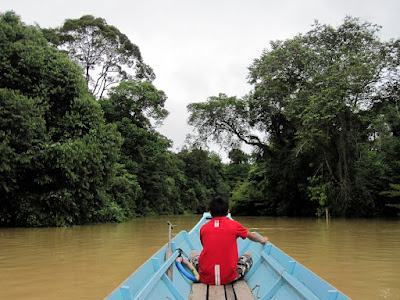 |
Travelling by motorized canoe. |
We arrived at our relatively remote longhouse village in the pouring the rain on a motorized canoe. As we moved up the Pelagus river, a tributary of the Rajang, I saw the bright paint and cinderblocks. Not exactly what I had expected. The longhouse was actually very similar to a US apartment building, but instead of going skywards, it was long. There were 46 families in the longhouse and each had its own apartment. The apartments were all about 1200 – 1500 sqft and those who could afford it had nice furnishings, televisions, tile floors, proper kitchens, etc. The village did not yet have a government electricity supply (though that is expected in the coming year), but every family had their own generator. Our guide told us about 90% of the village was Christian, with only some of the older and highly tattooed gentlemen still believing in ancestral spirits.
He said that 80%+ of longhouses were now fully modern like this one and those that were not would be in the next few years. He said that journalists often come looking for traditional longhouses and he gets somewhat irritated – he rightly pointed out that villages that live in a traditional longhouse essentially have missed all of the development that has taken place – they lack the money and resources that other areas have to upgrade and that is something to be sad about, not sought after. Fair point. Whether for tourism or architectural preservation, no one has the right to begrudge these people their advancement in an increasingly developed and modern economy.
Even with the all the modern conveniences present, some tradition certainly remained. Some of the younger gentlemen were also tattooed. People still sat outside of their private apartments in the very long public hallway and spoke to their neighbor. All references to home were to the longhouse, not my home or even my village. Nonetheless, lots of the families living in the longhouse were actually not there. Malaysians are some of the world’s most sought after migrant workers – they are educated, a very high percentage speak English and many of them have experience in natural resource extraction and other engineering pursuits. As such, many go to work in the rest of the South Pacific, the Gulf, etc. and then return home after 2 year contracts. As these men continue to come and go, Malaysia will clearly continue to grow richer and gain greater clout as its educated migrant workers influence the rest of the region.
We spent most of the day just relaxing. There is not a whole lot going on this far up the Rajang river, so we just read and enjoyed the great scenery. We spent a lot of the day feeling very sorry for the hotel. At the end of the day, the problem is really one of maintenance resulting from a lack of staff. The staff they have is very nice, but there are only 5(!) staff for huge grounds and 40 rooms. They are now in a vicious cycle where no guests means the management company will not hire more staff but current staff levels can not properly maintain the property meaning the no guests will come. I saw the reservation board for the rest of the year and NO ONE is coming. NO ONE at all. It looked like they only had about 50 guests year to date. You can tell the manager is sad. He is a kind Iban man named Nyaring who shows affection for his small staff and guests. When asked about how many guests there have been or are coming, he just kind of sighs and said that it has not been a good year, but they will come eventually.
I am not so sure. The forest is actually reclaiming the building. In the back building, the rooms without air conditioning where few people likely stay (our room was shockingly bug free), there are bugs everywhere and the paint is peeling away. The front entrance to the property looks like a boat graveyard. A few more years without proper maintenance and it might very well look like there was never even a hotel here.
Hiking out of the forest this evening, we heard the sound of gongs. The ladies on the staff who stayed back from the hike were playing the traditional Iban gongs that are set up in the dining room. The sounds were enchanting (it was actually the music that is on the hotel website – made the place seem awesome). When we arrived back, Nyaring and the two other staff members joined in on the drum and the other gongs. It was beautiful and they were playing for themselves – just to pass the time. After we went to bed, they kept playing. You could hear the music echo through the forest and though it was beautiful, the sounds kind of depressed me. There is so much potential in this place – it is so local and authentic with beautiful surrounds and caring staff – but it appears to be on the fast boat to irrelevance, or, frankly, jungle reclamation.
I wish them all the best, though I think it would be hard for Ms. Cupcake and I to actually recommend a friend to come here.


