I am typing this in a room with about 600 pairs of eyes. It is downright freaky. High above the Karawari River, one of the tributaries to the mighty Sepik, I am now in the land of the PNG headhunters, cannibals and carvers.
 |
| The airstrip at Ambua is a sloping gravel runway built on the side of a hill. |
How did we get here? We said goodbye to our Huli friends this morning. After only three days, it was actually a bit of an emotional experience. We became close to our guides and as the place was quite overwhelming, it was sad to leave when you felt like there was still so much more to learn. We set off on a small plane. A very small plane, in fact, on a sloped gravel runaway.
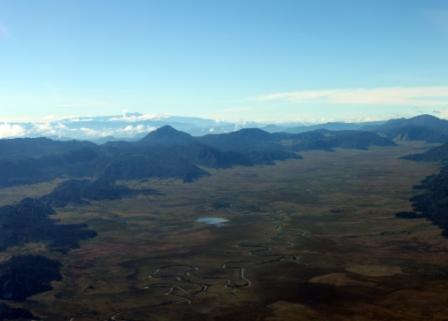
The scenery from the plane was stunning. That is an understatement – mountain range after mountain range, rivers carving through them, what we were seeing from our low flying plane was unbelievable. We touched down on a grass runway along the Karawari and then hopped in a small boat for about 30 minutes to get to the lodge.
 |
| The airstrip at Karawari, complete with seperate "gates" for arrivals and departures. |
The entire Sepik region, of which the Karawari is a part, is famous for its wood-carving. This is the main reason that Jen and I came – the shopping for primitive and tribal art along the Sepik. This carving explains the 600 pairs of spooky eyes staring at me from the amazing collection of masks and ancestral statues on display in the lodge.
 |
| The Karawari River. |
The region is beautiful. Lowland forest along flowing rivers. It is very hot here and there is about a 500 to 1 mosquito to human ratio, but we came prepared and are thus fine.
We visited a local school today. The kids sang us some songs and we donated some school supplies. What was most interesting was to see the ages of the kids in elementary/ middle school. They were all far too old, but were doing their best to learn to try to make something a bit more of themselves. We had been told by the lodge manager at Ambua that education is atrocious in PNG because of the quality of the teaching but, for what it was worth, these teachers, especially the head teacher, certainly seemed dedicated to the cause. They had lots of student teachers doing their practicums as well.
 |
| Making sago pudding. |
After that we headed to Kundiman, a small Yoakim village along the Karawari near to Amboin (where the lodge is). We learned how to make the only consistent part of the Sepik peoples’ diet – sago – essentially a flour made out of the bark of a tree. It was very bland - very, very bland and chewey - but the process to cook it was actually similar to a corn tortilla.
The village was fascinating – all of the various pieces of “art” that Jen and I want were all in use in everyday activity –Garamut drums, Aibom pottery, oars, canoe prows, etc. It was awesome.
However, my personal favorite part was the basketball court in the middle of the village. Look around this place – naked villagers, face paint, tribal dress, stilted jungle homes, dug out canoes – but they had a basketball hoop. This place has none, and I mean none of the “development” of the highlands. There is no Digicel, our lodge only has electricity for a few hours a day and there is a limited water supply, but this village has a basketball hoop. I am not going to lie – as primitive as I wanted this place to be as a tourist, it was pretty damn cool to see a basketball court. Instead of jerseys, the players will have different colored face paint and perhaps different flowers under their armbands to separate the teams.