Pages

Saturday, August 14, 2010

Exploring the Karawari

Our guide Chris is from the Karawari region. He is also a Yoakim and a master carver from his village Manjamai. He’s been able to provide pretty unique insight to the region since his grandfather was a Yoakim warrior and cannibal. It is not everyday that you get to hear those stories. He explained that the Kamangabi, the local “art,” is actually used as a guide to help the warriors figure out the location of the enemies. We bought one from our guide’s village – his uncle was the master carver that made it. It is that intimacy with the artist that makes this area so unique.

Kamengabi
We visited two other villages (both with basketball courts I might add) – one, Gonmai, another Yoakim village, along the Gonmai River, a tributary to the Karawari, and then a Karim village, Yimas, a bit further down the Karawari.  The Karim welcomed us with a dance dedicated to helping them with the fish catch. It was kind of indescribable in words, but hopefully the pictures below do it some justice. 


Gonmai was fascinating. It was probably the most remote place that I’ve ever been. They had a newly built Haus Tambaram, or Spirit House, that they were completing as we were there. The columns were being painted and there was even scaffolding on the outside. It was beautiful. They had an absolutely breathtaking Garamut drum inside that our guide offered to help me negotiate, but Ms. Cupcake made me decline. It weighed 50+ pounds and would have cost a fortune to ship, but it was one of the most beautiful pieces I have ever seen. What a mistake. All I can think about it is how badly I wish that I’d purchased that drum.

The garamut drum in the Haus Tambaram
We are off to the Sepik on the Sepik Spirit cruise tomorrow. It was the part of the trip that I had been most looking forward to. However, coming to the Karawari was extremely unique. It is partly the same as the Sepik region we will see tomorrow, but also very different with its Kamangabi and cannibals. Chris put forth a lot of passion in guiding us – explaining the local culture, finding the 12-wire bird of paradise and a beautiful hornbill at 6am on a deserted river bank and ensuring that we bought the best Kamangabi. It is very, very important that I know where to find my enemies – like Ms. Cupcake for making me leave the drum behind.

Woman fishing. Women spend so much time in their canoes that they have little fires that they use to cook food on board.
Hornbill!!
The evening ended with Jack, our extremely dedicated and lovely waiter at Karawari Lodge, bringing us a few glasses of his patented lemonade with a secret ingredient. While we sipped on our heavenly drink, the Karawari Bamboo Band, a band from the Karim village of Yimas that we visited earlier in the day, played PNG tunes on PNG instruments. They banged on bamboo with flip-flops while wearing their Karim dress and beating their kudu drums. It was awesome. It was the perfect end to the day. 

Karawari Bamboo Band
A kookaburra dancing to the music

Ambua to Karawari (August 9th)

I am typing this in a room with about 600 pairs of eyes. It is downright freaky. High above the Karawari River, one of the tributaries to the mighty Sepik, I am now in the land of the PNG headhunters, cannibals and carvers.

The airstrip at Ambua is a sloping gravel runway built on the side of a hill.

How did we get here? We said goodbye to our Huli friends this morning. After only three days, it was actually a bit of an emotional experience. We became close to our guides and as the place was quite overwhelming, it was sad to leave when you felt like there was still so much more to learn. We set off on a small plane. A very small plane, in fact, on a sloped gravel runaway. 


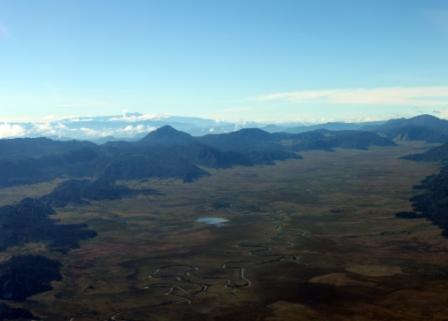
The scenery from the plane was stunning. That is an understatement – mountain range after mountain range, rivers carving through them, what we were seeing from our low flying plane was unbelievable. We touched down on a grass runway along the Karawari and then hopped in a small boat for about 30 minutes to get to the lodge.

The airstrip at Karawari, complete with seperate "gates" for arrivals and departures. 
The entire Sepik region, of which the Karawari is a part, is famous for its wood-carving. This is the main reason that Jen and I came – the shopping for primitive and tribal art along the Sepik. This carving explains the 600 pairs of spooky eyes staring at me from the amazing collection of masks and ancestral statues on display in the lodge. 

The Karawari River.

The region is beautiful. Lowland forest along flowing rivers. It is very hot here and there is about a 500 to 1 mosquito to human ratio, but we came prepared and are thus fine.


We visited a local school today. The kids sang us some songs and we donated some school supplies. What was most interesting was to see the ages of the kids in elementary/ middle school. They were all far too old, but were doing their best to learn to try to make something a bit more of themselves. We had been told by the lodge manager at Ambua that education is atrocious in PNG because of the quality of the teaching but, for what it was worth, these teachers, especially the head teacher, certainly seemed dedicated to the cause. They had lots of student teachers doing their practicums as well.

Making sago pudding.
After that we headed to Kundiman, a small Yoakim village along the Karawari near to Amboin (where the lodge is). We learned how to make the only consistent part of the Sepik peoples’ diet – sago – essentially a flour made out of the bark of a tree. It was very bland - very, very bland and chewey - but the process to cook it was actually similar to a corn tortilla. 


The village was fascinating – all of the various pieces of “art” that Jen and I want were all in use in everyday activity –Garamut drums, Aibom pottery, oars, canoe prows, etc. It was awesome.


However, my personal favorite part was the basketball court in the middle of the village. Look around this place – naked villagers, face paint, tribal dress, stilted jungle homes, dug out canoes – but they had a basketball hoop. This place has none, and I mean none of the “development” of the highlands. There is no Digicel, our lodge only has electricity for a few hours a day and there is a limited water supply, but this village has a basketball hoop. I am not going to lie – as primitive as I wanted this place to be as a tourist, it was pretty damn cool to see a basketball court. Instead of jerseys, the players will have different colored face paint and perhaps different flowers under their armbands to separate the teams. 

Huli Women

Sunrise at Tari Gap

The Huli lands in the Southern Highlands province around Tari are frankly overwhelming. The beauty and the overwhelming kindness of the people is incredible – more so when juxtaposed with an ingrained culture of violence.

Tari Gap
We leave this region tomorrow to head to the Sepik river, and the amount I’ve learned in the past two days is frankly indescribable. The Hulis are people, whom despite the development there’s been and that that’s coming, cling with great pride to their traditional ways. We witnessed spirit dances, sun dances and visited spirit doctors. These men had the power to rid people of spirits haunting them, but to also provide the spells necessary to help others kill. Unlike travel in other slightly more frequented destinations, traditional dress here is real. It is the way of life. Sure people dress sometimes in the standard western cast-offs, but they may be wearing jeans a t-shirt and simultaneously a moss headdress.

The spirit doctor, working on a treatment for a sick man. 
Missionaries and others have tried to “modernize” the culture but have largely been unsuccessful, if that is that term. The above “spirit” practices were all banned, and if you ask now in an official context, they tell you they still are. Dig a little deeper – they’re not. 

This morning we visited a woman’s village. One of the staff members of the lodge is from this village and she has organized the ability for certain groups of guests to visit to witness the “hard life” of a Huli woman. Men have multiple wives and as men need to constantly be prepared for war and clan fighting, women must take care of everything else. Remember the adage of “Land, Women, Pig” – well, the truth is that they are all the responsibility of the women. The Huli gardens are beautiful. They are spacious and abound in fresh vegetables (sweet potatos, herbs) and are habited only by people and pigs. Everything is immaculately clean and organized.

Planting sweet potatoes in the garden. 
The women explained their daily lives as well as their typical travails. Travails they are. Domestic violence is the norm. Women go to the “magic woman” to try to prevent their husbands from getting more wives. They say it works – the evidence does not bear this out.

A house in the women's village.
The Huli people take their inspiration from the birds of paradise that abound in the area. They dance mimicking the way the birds dance around and “show” when trying to mate. It is incredibly ironic that the dancing parodies such harmless creatures when people will kill at will. We heard the comment while here that “if we hear that people are fighting, we will go join in immediately. We do not think twice about defending our clan.” This morning with the women we learned in great detail about “payback” and “compensation”. We learned that the real reason we couldn’t get out at the market yesterday was because four women were dressed in their mourning “compensation” clothes and it was that, not our “whiteness” that could have led to violence at any moment. If they did not receive their adequate compensation, they would inflict payback and kill a member of the opposing clan.

From left to right - traditional clothes, "compensation clothes", mourning clothes
Our time in Huli land ended this evening with a magical musical performance. A few clansmen sang with guitars – brought by the missionaries – and a couple performed Huli dances. It was quite a moment. We’ve done it all here in our 3 days – we’ve seen the birds of paradise, we visited the clans and learned about the culture. I bought my Digicel top-up card and already seen how PNG LNG is altering this area forever.

Spirit dancers
The highlight for Jen was undoubtedly when the cook gave her two of the recipes she wanted. It took him two full days to get her the recipes because the cook can not read or write and had to dictate. The recipes involved phrases like “chop-chop.” The cook was so nice and cute explaining the recipe and how she needed to make them. The cook has five wives. The recipe will be posted when we return. 

Just off the Highlands Highway

On September 11, 2001, a flight of then truly intrepid travelers made it to Tari. Most of the group was American. The news was not fully understood by any of the Papua New Guineans, more accurately, Hulis, working at Ambua Lodge, but they knew that they had always liked the American tourists that had come through. The Huli people, being both protective and violent in nature, were ready to fight for the Americans. They had a map up in the lodge and some of the Americans were showing pointing to Afghanistan on the map to show where the believed terrorists were based. 

Using the Australian map, where Papua New Guinea is in the middle, the Hulis were convinced that the war would take place in PNG since it is located in the middle. To calm down the Huli staff, those explaining the situation said that they should not worry because the soldiers would just go the other way, e.g. overland through Europe. The Huli workers did not understand – they didn’t get that the world was round as they were looking at a flat map. This is really not that surprising when you realize that up until the 1930’s, their universe existed inside of a few mountain ridges and they didn’t have the wheel.


This is the land to which PNG LNG is coming. More than half of our lodge guests right now are PNG LNG workers. They are very nice (and even gave us two PNG LNG shirts as souvenirs since we knew about the project), but they are very, very out of place. Oil workers are used to needing to conduct their business in far off and often dangerous places, but even they confessed that this is a bit different. These workers are actually just here to locate the appropriate places for training facilities, but even their job is tough.


Just off the ever busier “Highlands Highway” that passes through Tari and all of the surrounding villages towards Mt. Hagen, the largest highland city, the 1930’s world is still visible. This morning we visited the tiny homestead of Tigibi. There are not really villages in the traditional sense here since Huli live in family compounds surrounded by high mud walls to protect them from other clan invaders. They performed a sing-sing for us. This was only different from their day to day for the extra make-up and hairwigs they put on – otherwise, this was pretty standard. The sing-sings are performed throughout the year at special events. It was an incredible experience. It was extremely intimate and we were able to speak to them and learn more about the culture and tradition in a setting very comfortable to them. They were very friendly, but one of them had a highly visible stab wound from recent tribal fighting.


Also, just off the road, believe it or not, are PNG’s famous bird of paradise. Early morning birding, feeling very much like the crew of Planet Earth, we set off in search of Stephanei’s Astrapia and the King of Saxony. In a rare feet, we saw both. They were positively beautiful and were undisturbed by the large semi’s passing by preparing for work at PNG LNG. All of this at 6am on a Saturday.


We visited two other small settlements throughout the day and learned about the Huli Wigman tradition where young man go to “wig” school to grow their “everyday” and ceremonial” wigs for 18-36 months at a time. These men could not have yet had “relations” with a woman or killed a pig. Otherwise, the magic spell they use to grow the wigs wouldn’t work.


We returned back to the lodge and had a chat with the manager on politics and business in PNG. Abundant in natural resources, the place should, also figuratively, be a goldmine. But, it seems, as with pretty much every resource rich (and lots of other) country globally, most of the wealth simply lines the pockets of the politicians. Corruption is endemic here and there is essentially zero hope it will get better. That is tragic in a country that could benefit so much from this wealth, but there is almost no optimism from the people that anything will really change. Exxon and the various international agencies that are funding the project have promoted large scale community involvement, but no one thinks this will work due to the government.

The culture is fascinating to a point that is almost beyond words, but the violence is so omnipresent and matter-of-fact that you only wonder what the area would be like if they had handguns instead of bows and arrows as their weaponry. Interclan warfare starts on a dime – we would not stop in the Tigibi market today for fear that our white presence could incite discussions and fighting. MSF staff located in the area that we spoke with at the lodge has been sent here to try to combat domestic violence – this is a term barely even understood by the Hulis as it is not a term that carries a stigma or even really definition.  


The area around Tari is positively beautiful. The waterfalls are spectacular, the terrain is magnificent and the birds are vibrant. The people are friendly. Western development, moors and technology are almost no where to be seen but the aspects that will arrive here first, in combination with the centuries old culture could be quite inflammatory. This will be an interesting place to watch in the coming years. 

Land, Women and Pigs


Primo, the village chief, greeted us on the gravel landing strip in Tari. Wearing full chieftain dress, he strangely looked a bit out of place. Though the airport is actually nothing more than a thatched hut, you sensed development.

It was a bit of a miracle we made it to Tari. Our connection in Port Moresby was less than 30 minutes once we arrived late and the chances of making it were slim. The gracious Air Nuigini staff on the flight from Singapore moved us to Business Class half way through the flight just so we could jump the line at immigration. We were fortunately met by more Air Nuigini staff and hand held through immigration, customs and checking in to our other flight so that we could make it to Tari. It was the only scheduled flight to Tari this week, so we really had to make it.

The Tari airport has no electricity. We had to buy paper tickets and have them mailed. Seems stone age enough, right? That is all about to become very different.

Tari is very much on the cusp of great change. Perhaps that is even the wrong phrase – Tari is about to become the world’s foremost case study in large natural resource based foreign direct investment in the remote and primitive third world. The Tari basin, home to the Huli people, sits above some of the world’s largest and most accessible reserves of natural gas. With ever rising oil prices, that is no small matter. Earlier this year, ExxonMobil, together with a consortium of Japanese and Australian partners, formed a partnership with the local people and government as significant stakeholders and closed the world’s largest ever project financing in the heart of the financial crisis – PNG LNG. Worth more than US$ 14 billion, the project is a behemoth. This find, which was not only the headline of the financial press but has dominated the PNG news media, sits only a few kilometers outside of Tari.


Driving up from the airport to Ambua Lodge, our guide, Paulus explained what we were seeing along the road. The new road, in fact – built by ExxonMobil – that made the drive from Tari airport to the lodge, for better or worse, go from 3 hours to 30 minutes. He pointed out Huli intraditional dress walking along the road, he explained their still very traditional lifestyle led by the concept, in descending order of importance, of the holy trinity of “Land, Women, Pigs.” Despite all of the western influence in his life working at the lodge, he has three wives and more than 10 children. He explained that the concept of “compensation” is very important in Huli culture – if I were to say, kill your brother, I would owe you “15 x 15 pigs”. That debt will take a very long time to repay and I will be shamed until I pay it off.

All of this was described in a very nonchalant fashion. As we were getting closer, to coordinate lunch upon our arrival at the lodge, he drew out his cell phone and called. Ubiquitous cell phone usage, if you can call it that, is also new in PNG. Digicel, the Irish emerging markets telecom operator, started operations here a few years ago. Their marketing is everywhere and people love the service. Paulus explained, though, again in his highly nonchalant manner, that cell phones have been good and bad. He says that day to day life has certainly become easier. This, though, has been at the expense of much more strategic inter-clan fighting. Now, fighters, who execute such battles with bows and arrows and machetes, can coordinate their attacks and retreats via mobile. Probably not the development that the  Digicel CEO had in mind.


After lunch we went for a few mile hike in the highland jungle forest. We saw beautiful pristine waterfalls and vine suspension bridges built by the Hulis to make their way around the forest. The wilderness was striking – all not too far from what is about to be out of the biggest gas projects on earth.


Today has been a fascinating day. We knew to expect this coming to Tari, but to see that change coming so rapidly to an area still so primitive at heart is quite an experience. For Jen and I, it was at least nice to use Digicel to text our family and let them know we arrived safely. We won’t be coordinating any clan fighting – for now. 

Singapore - NOT boring!

(ed: We just got internet in Mt Hagan and it is very slow. We are putting up a few days worth of stuff, and then will catch up completely back in Singapore.)


I should start this by saying that I have no idea when this post may actually make it to the internet. We are now sitting on a flight en route to Port Moresby, PNG (via KL – yes, I am asking the same question).
Anyway, suffice it to say that today more than made up for the disaster that was yesterday.
Andy, our more than helpful check-in friend at the St. Regis, managed to work some miracles last night when we got in that not only got us a great suite but also secured us a much needed late check-out so we could have a full day and then be off to PNG.


We were up early on our last full day in Singapore. After gorging on hotel breakfast, we set off first for the colonial district in the heart of the city. It looked like a newer, cleaner, more thoughtfully planned version of London – which I suppose it should. We had confirmed again just how late of a starting city Singapore is – we roamed the streets virtually alone until almost 8:30 when the morning commute spontaneously began.
From there, Jen was dying to go to the zoo. Singapore is famous for its zoo and though I am not really the zoo type, I acquiesced in good marital fashion.


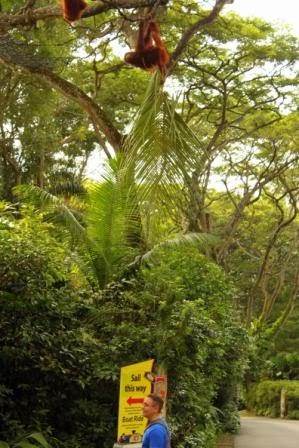
It was indeed quite the zoo. Instead of having animals in cages or behind glass walls, they actually set up wide moats (or have no barrier at all, like for kangaroos and lemurs) so that there is no synthetic barrier between you and the animals. As you can observe from the below photo – that includes Orang-utans!!! We scoped out the animals that we might see in PNG and Borneo later in the trip, spent some QT in the gift shop buying exotic stuffed animals and then headed back downtown. To be more precise, Chinatown – we were starving.


Over the next four hours, we slowly meandered through the beautiful restored streets of Singapore’s original (and current) Chinatown. The shop fronts were colorful and vibrant, the atmosphere fun and the streets, well, clean – exactly as you would expect from Singapore, not what you would expect from Chinatown. I loved Chinatown. We went from Hawker center to Hawker center (including, for those who might wander through here someday, La Pu Sat, Amoy Street and Chinatown Complex) sampling the local delights - soya sauce noodles and chicken, Singapore coffee, chicken rice and pork buns. All were delicious. We wiled away some time as well at Tea Chapter, a beautiful old tea house, where the staff taught us how to execute a full proper Chinese tea service. We had had some education in this before, but never to quite the degree we learned this afternoon.


All in all, we walked about 15 miles over the course of the day in about 95 degree heat, but couldn’t have been happier. Singapore rocks. Many times throughout the day we wondered aloud why everyone always says that Singapore is boring – it most definitely isn’t. There are tons of highly-recommended local and international museums we won’t have time to make it to, concert halls, opera houses, shows and more. It is a vibrant city with tons to see and do. It is clean, safe super efficient and has undoubtedly the best taxi drivers in the world. The Timeout Singapore cover says it all.


After a not as quick as desired stop for a second fitting at the tailor and a very quick indeed stop in Little India to get a tailor-made Sari for Jen, we booked it back to the St. Regis to GTL (more accurately, shave, shower and change) and get to the airport for our flight to PNG.

Two other interesting anecdotes from the day:

At the Chinatown Complex, we followed the adage of looking for the longest line. I confirmed with the on-line locals that it was worth it and waited patiently for my chicken and noodles. The lady in front of me was a negative Singaporean who worked for Credit Agricole. We chatted about travel and food in Singapore, but we also struck up the banking conversation that you would expect. She asked, quite abruptly: “How is the mood in the states? What are you guys doing? We just keep waiting for you to recover and nothing is moving.” We didn’t have much of a response – what do you say to someone who’s GDP grew by 20%+ annualized last quarter?


On the flip side, while Jen was getting fitted for the Sari I had to run to an ATM to get money to pay for it. To show me the closest one, the shop keeper sent me out with her brother. I joked that we loved Singapore so much we wanted to move there. He answered with an emphatic “no.” “This place is terrible,” he insisted; “I was born here and have lived here my whole life. The government is oppressive, things are too strict. It is not a place to live.” He continued on to explain the lack of some freedoms and that the economy and clean appearance come with a cost.

The sights, sounds and food are interesting. So are the economy and politics.

Air Niugini is now insisting I shut this off as we land in KL. Nothing like going northwest to go south east. Hopefully we’ll be able to post this and other notes soon, but as we have been told numerous times from our PNG guides “you never know what is going to happen in PNG.”

Wednesday, August 4, 2010

Striking Pilots!!

As I plan these trips to remote locales, I often times forget that there can be some transit pain involved. As I write this, Ms. Cupcake and I are being thrown around a bit inside an Airbus 330 in a completely typical southeast asian summer storm. Never pleasant.

There is not too much good to say about today. We were really in the middle of nowhere and, as you can imagine, to get from A to B when A is the middle of nowhere, it can take some time. We were up and out of our hotel before dawn to get to the air strip (airport is a bit generous a term) to get back to Manila. Our flight was early because we wanted no doubt that we would arrive back in Singapore tonight.

Turns out that flight wasn’t the issue. As we sat waiting, in my case very impatiently, for our flight from Manila to Philippines, we read the articles in all the papers about how 25 of the Philippine Airlines pilots recently defected (that is the word that the local papers are using) to other international carriers. Therefore, there were flights without pilots. Our already very annoying 6 hour layover became 9 hours. We ate airport dim sum (not good), airport pork buns (good), each read a book cover to cover and then finally boarded our now very bumpy flight.

From 8-4 Transit

We should be landing shortly and then straight to the hotel. It has been a long and irritating day, but tomorrow we’ll explore more of Singapore. Then, the redeye to PNG.